

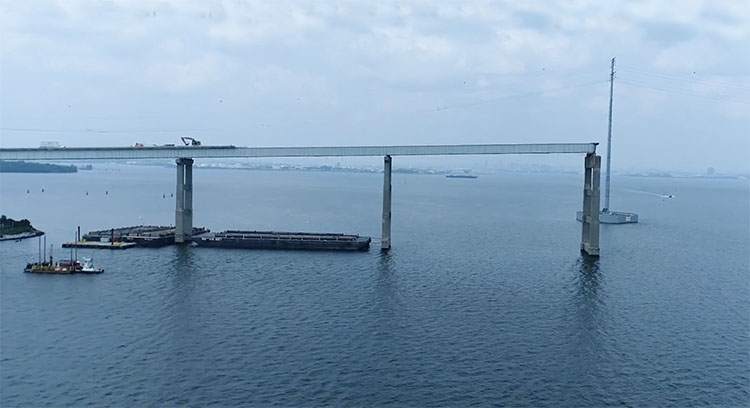
ABOVE: August 2025 drone image of demolition work being done on the Key Bridge. Photo: Michael Blain.
During an in-person industry forum about the massive Key Bridge rebuild project held on June 18, 2026, a high-ranking spokesperson for the Maryland Transportation Authority (MDTA) stated that the agency is currently “evaluating this contract for a project labor agreement.”
Speaking about the next major phases of one of the largest infrastructure projects in Maryland’s history, MDTA Deputy Director of Project Development Jason Stolicny stated that the PLA evaluation was being done “in compliance with our executive order on workforce development.”
“In compliance with our executive order on workforce development, we are evaluating this contract for a project labor agreement.”
– MDTA Deputy Director of Project Development Jason Stolicny
“In compliance with our executive order on workforce development, we are evaluating this contract for a project labor agreement.”
– MDTA Deputy Director of Project Development Jason Stolicny
MD Workforce Development Executive Order and PLAs
The evaluation of a PLA is dictated by Executive Order 01.01.2023.22, signed by Governor Wes Moore in 2023. The order authorizes state agencies to consider requiring PLAs for large-scale public works projects where the state’s commitment exceeds $20 million.
A PLA is a pre-hire collective bargaining agreement that establishes terms and conditions for labor on a project. They also typically have stipulations that prioritize local hiring, promote workplace safety and guarantee opportunities and work hours for apprentices.
In issuing the order in 2023, the Moore administration stated that its aims included increasing family-supporting jobs, providing stability in the labor force to prevent shortages of skilled labor, and ensuring projects are completed on-time and on-budget.
When evaluating a project for a PLA, the state must consider factors such as:
- The potential for labor disruptions (strikes or slowdowns).
- The project’s size, complexity and urgency.
- The impact on project costs and competitive bidding.
- The ability to advance socioeconomic policies, including supporting minority-owned and women-owned businesses.
State Decided to ‘Off-Ramp’ Initial Lead Contractor
While Kiewit Infrastructure Co. was initially hired to lead the bridge rebuild project, MDTA announced in April 2026 that it had chosen to “off-ramp” the contractor following failed negotiations over the final Phase 2 construction costs and timelines.
Kiewit has been working on the bridge under a voluntary PLA. The company is being paid to finish Phase 1 through the end of 2026. This includes driving foundation piles, building a temporary work trestle, and finalizing the bridge design to a 70% level.
Rebuild is Massive in Size and Scope
The Key Bridge rebuild project is staggering in both its physical size and its financial requirements. It includes approximately 11,000 feet of bridge construction along the I-695 Baltimore beltway. At the heart of this reconstruction is a new 1,665-foot main span cable-stayed bridge that will soar over the federal navigational channel. The total length of the cable-stayed portion alone will reach 3,365 feet, supported by iconic H-shaped concrete pylons reaching 602 feet into the air.
Ballpark costs for this central component — the Main Span and Marine Approaches contract (identified as KB-4907) — is currently estimated to be between $3.5 and $4 billion. This does not include other necessary contracts, such as demolition work estimated at $50 million to $100 million, and land approach contracts totaling between $500 million and $700 million.
Current Status: Piles, Trestles and Procurement
While the MDTA prepares for future bidding, significant work has been happening on the water. Under “early work packages,” Kiewit Infrastructure Co. has been installing 8-foot diameter steel pipe piles for the foundations and vessel collision protection systems of the main pylons. Company workers are also building massive access trestles — temporary work platforms 36 feet wide extending from Sollers Point and Hawkins Point — to provide a stable base for the heavy machinery required to build the pylons.
The procurement for the main bridge is about to accelerate. The MDTA expects to issue a Request for Qualifications (RFQ) in July, with the goal of identifying a shortlist of qualified teams by the fall of 2026.
The Roadmap: Next Phases for the Bridge
The timeline for the rebuild is ambitious but clearly defined. Following the shortlist identification this fall, the MDTA will issue a Request for Proposals (RFP) in October 2026. Proposers will then engage in one-on-one confidential meetings through the winter, with final technical and price proposals due in March 2027. If the schedule holds, a Notice to Proceed for construction is projected for the summer of 2027.