

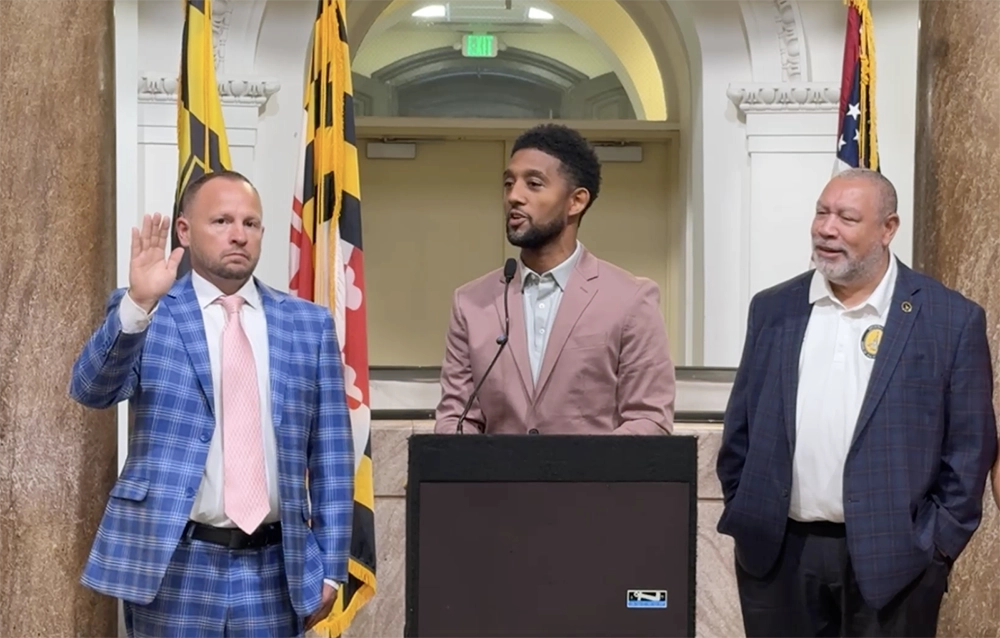
After serving as a member of the Baltimore City Wage Commission for several years, Eastern Atlantic States Carpenters’ Representative John Barber is stepping into a new role as the commission chair. He was officially sworn in by Baltimore Mayor Brandon Scott on August 3, 2026.
As he looks ahead to his tenure as commission chair, Barber says he is focused on bringing transparency to city job sites, specifically regarding the posting of wage rates.
“Currently, it’s not specified where it has to be,” he noted, explaining in a Zoom interview earlier this week that required wage rates are often posted inside job trailers, where average workers have no reason to go.
“That’s gonna be one of my goals as the chair,” he added, “to help implement getting more specific things on the books for where these postings need to be… so workers coming in and out of a job can see.”
“It is a privilege to serve the working people of Baltimore, who unfortunately get cheated on jobs daily.”
– John Barber, Representative
Eastern Atlantic States Regional Council of Carpenters
“It is a privilege to serve the working people of Baltimore, who unfortunately get cheated on jobs daily.”
– John Barber, Representative
Eastern Atlantic States Regional Council of Carpenters
The Wage Commission is a five-member body appointed by the mayor and approved by the city council, consisting of experienced individuals dedicated to ensuring that the city’s wage laws are followed correctly. The commission is responsible for enforcing minimum wage, living wage and prevailing wage laws, as well as the city’s Displaced Service Workers Protection law.
To oversee these efforts and hear ongoing cases, the commission holds public meetings on the first Thursday of every month. Members of the commission serve as uncompensated volunteer board members and do not receive a salary or pay for their service. The previous chair was Sheryl Wood, who served for more than 10 years on the commission.
Barber underscored that wage theft is a widespread and significant issue in Baltimore City.
“It is a huge problem,” he said. “Unfortunately, enough workers don’t want to speak up. They’re scared, they don’t know their rights.”
He noted that misclassification of job titles is one of the most common ways contractors fail to pay workers what they should be paid, with immigrant workers often being the target of such exploitation.
“Typically, the contractors like to pay everyone as ‘laborers’ instead of electricians or plumbers or carpenters,” he said. “That happens every day.” Even, he added, when they are explicitly doing the work of one of those skilled trades.
To address such systemic issues, the commission is authorized to investigate complaints, inspect payroll records without prior notice and formulate educational programs designed to eliminate substandard wages. The city employs a task force of four investigators who proactively police job sites.
The commission’s work recently entered a new era with the implementation of “LCP Tracker,” a digital database that Barber says enables investigators to be “proactive instead of reactive” by scrutinizing payrolls more efficiently than the previous paper-based system.
The urgency of this work is underscored by national data regarding wage theft. A recent study found that Maryland leads U.S. states in wage theft violations. The study analyzed U.S. Department of Labor data and calculated that companies in Maryland committed 12,639 wage theft violations over three years, with an average of $2,221 in back wages owed per employee.
Despite such challenges, Barber says he is deeply committed to the commission’s mission of protecting Baltimore’s wage earners.
“It is a privilege to serve the working people of Baltimore,” he said, “who unfortunately get cheated on jobs daily.”
He added that he intends to push for stricter consequences for repeat offenders: “I do plan on being the first to make some recommendations in regards to debarment, because we do have repeat offenders that continually come in there month after month.”