
Photo: Courtesy of UA Local 486
The Construction Trades Workforce Initiative (CTWI) and the Baltimore-DC Building Trades Council are participating in a new national collaboration — known as the Infrastructure Pathways Project (IPP) — that is designed to expand access to the building trades and strengthen “inclusive pathways” into union construction careers.
“The purpose of the project is to bring regions across the country together to talk about how pre-apprenticeship can serve as an intermediary to support local hire initiatives,” said Beli Acharya, Executive Director of the Construction Trades Workforce Initiative (CTWI).
“The purpose of the project is to bring regions across the country together to talk about how pre-apprenticeship can serve as an intermediary to support local hire initiatives.”
– Beli Acharya, Executive Director
Construction Trades Workforce Initiative
“The purpose of the project is to bring regions across the country together to talk about how pre-apprenticeship can serve as an intermediary to support local hire initiatives.”
– Beli Acharya, Executive Director
Construction Trades Workforce Initiative
Co-led nationally by TradesFutures and Equal Rights Advocates (ERA), the IPP is supported by a $1.5 million grant from the Families and Worker Fund. The initiative is in part a response to the more than $20 billion in federal construction funding helping to drive growing demand for skilled labor.
The project is currently active across five national jurisdictions: Baltimore/DC, Philadelphia, Milwaukee, Central New York, and the Pacific Northwest. It specifically targets workforce disparities in an industry where women still represent only 4.2% of trades workers.
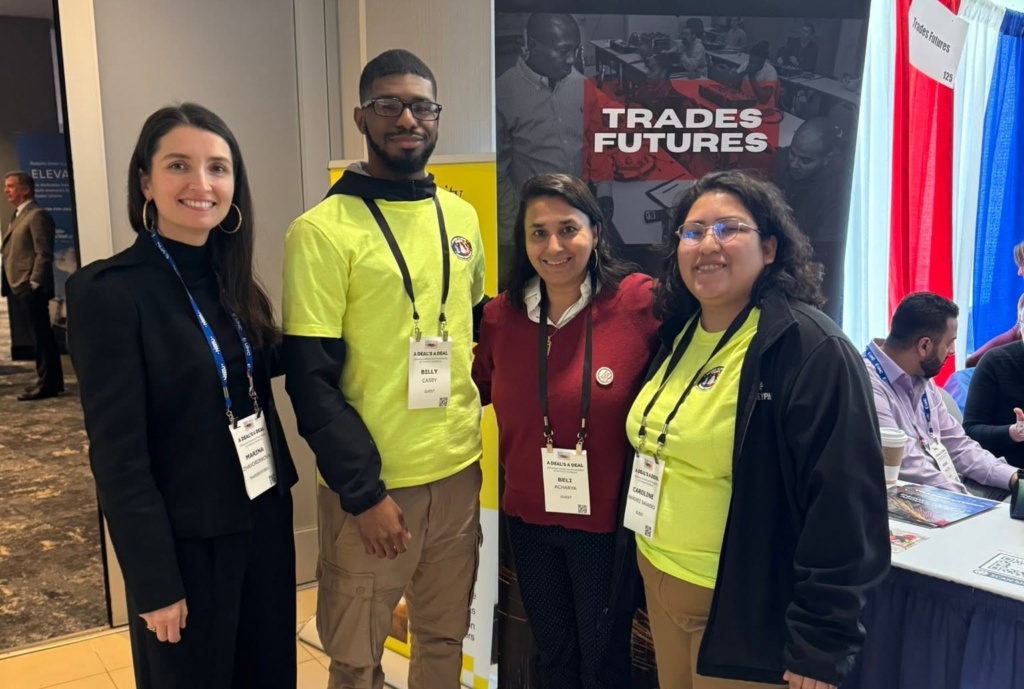
From L-R: TradesFutures Executive Director Marina Zhavoronkova, Raising the Bar participant Billy Casey, Construction Trades Workforce Initiative Executive Director Beli Acharya and Raising the Bar participant Caroline Ramirez-Navarro at the 2026 NABTU Legislative Conference in Washington, DC. Photo: Courtesy of CTWI.
In a Zoom interview this week, TradesFutures Executive Director Marina Zhavoronkova posed a key question that the IPP intends to answer: “How can we connect our graduates to really good program or employment opportunities, particularly on large infrastructure projects across the country and target locations?”
Zhavoronkova explained that a primary goal of the IPP is to utilize policies such as local hire guidelines or apprentice utilization targets within Project Labor Agreements (PLAs) to increase demand for graduates of apprenticeship readiness programs.
“In many cases, we have local or targeted hire requirements on projects, but they don’t really lead to lasting change, necessarily, in terms of hiring for that community,” she added. “Our goal is to ensure that there’s a local hire process — not just policy — that would potentially be implemented across a variety of projects.”
“Our goal is to ensure that there’s a local hire process — not just policy — that would potentially be implemented across a variety of projects.”
– Marina Zhavoronkova, Executive Director
TradesFutures
“Our goal is to ensure that there’s a local hire process – not just policy – that would potentially be implemented across a variety of projects.”
– Marina Zhavoronkova, Executive Director
TradesFutures
The IPP provides participants with technical assistance on data collection, compliance, and recruitment strategies. In the Baltimore region, CTWI is partnering with the Baltimore-DC Metro Building and Construction Trades Council, the Maryland Department of Transportation (MDOT), and the Baltimore Mayor’s Office of Employment Development (MOED). The Mid-Atlantic team is focused on developing a standard operating procedure (SOP) to coordinate the roles of various stakeholders when managing local hire goals under a PLA.
“Our model is really around understanding that no one entity can make this pipeline successful in terms of getting workers into the construction trades, but that all have a role to play,” said Rukku Singla, Director for Gender Equity in Infrastructure with Equal Rights Advocates.
“Our model is really around understanding that no one entity can make this pipeline successful in terms of getting workers into the construction trades, but that all have a role to play.”
– Rukku Singla, Director for Gender Equity in Infrastructure
Equal Rights Advocates
“Our model is really around understanding that no one entity can make this pipeline successful in terms of getting workers into the construction trades, but that all have a role to play.”
– Rukku Singla, Director for Gender Equity in Infrastructure
Equal Rights Advocates

“Union work, and the construction trades in particular, actually has a very low gender pay gap,” added Singla, emphasizing that the project focuses on ensuring trades pipelines are open to women and that construction jobs “are worksites that are respectful and inclusive of all their workers.”
In Baltimore, the project team is piloting a data dashboard to visualize hiring progress, making it easier for contractors and agencies to track whether community hiring goals are being met. This framework is being designed as a vetted model for major regional infrastructure projects, such as the Frederick Douglass Tunnel — a massive, multi-billion dollar infrastructure initiative to construct a modern, high-speed passenger rail tunnel under Baltimore that will serve as a vital new corridor for electrified Amtrak and MARC trains.
“The Amtrak project is a really good project to show that on mega-infrastructure work, the unions come in ready to do their part,” said Acharya. “Increasingly, in our region, we are winning more and more project labor agreements. And so what this means is we really need a scripted blueprint for how all the stakeholders engage around meeting local hire goals.”

“Union work, and the construction trades in particular, actually has a very low gender pay gap,” added Singla, emphasizing that the project focuses on ensuring trades pipelines are open to women and that construction jobs “are worksites that are respectful and inclusive of all their workers.”
In Baltimore, the project team is piloting a data dashboard to visualize hiring progress, making it easier for contractors and agencies to track whether community hiring goals are being met. This framework is being designed as a vetted model for major regional infrastructure projects, such as the Frederick Douglass Tunnel — a massive, multi-billion dollar infrastructure initiative to construct a modern, high-speed passenger rail tunnel under Baltimore that will serve as a vital new corridor for electrified Amtrak and MARC trains.
“The Amtrak project is a really good project to show that on mega-infrastructure work, the unions come in ready to do their part,” said Acharya. “Increasingly, in our region, we are winning more and more project labor agreements. And so what this means is we really need a scripted blueprint for how all the stakeholders engage around meeting local hire goals.”
