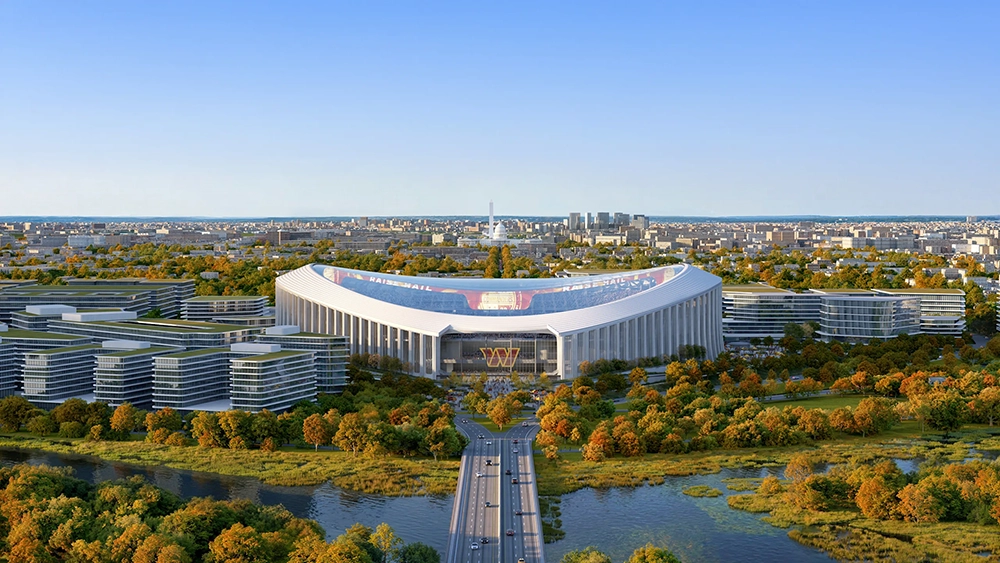
ABOVE: An artist’s rendering of the new Commanders’ Stadium. Photo: Washington Commanders.
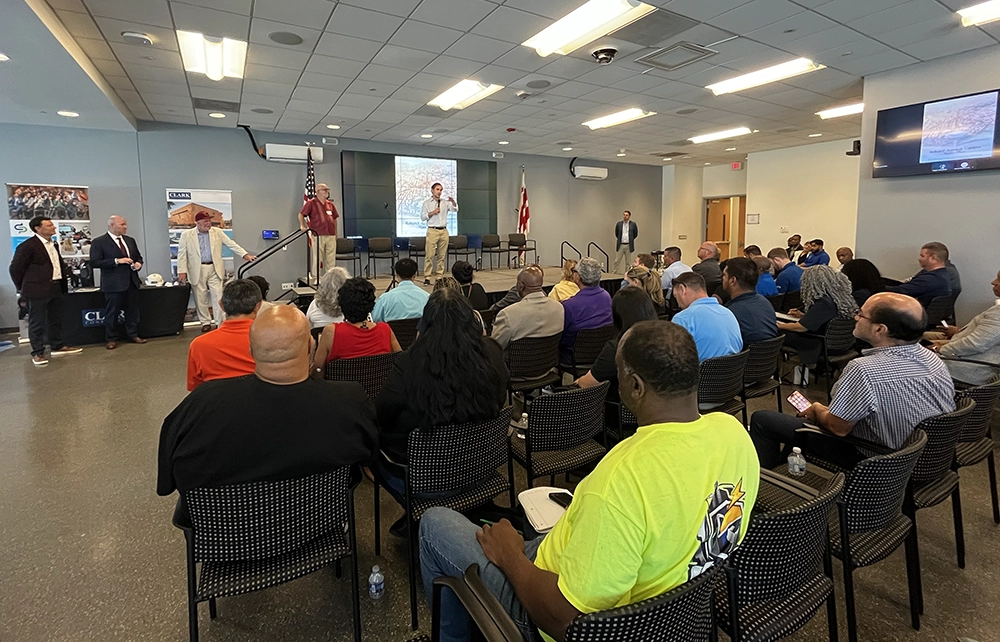
Building trades leaders, the Washington Commanders’ top construction executive, District building officials and representatives from the Clark-Mortenson-Smoot general contractor joint venture gathered for a panel discussion last week to highlight upcoming construction opportunities at the new RFK Stadium and surrounding development.
A key theme was reiterated by panelists and audience members throughout the event: The redevelopment of the RFK campus is not only a stadium project. It is also a massive opportunity for local construction trades, D.C. residents and District-based small businesses to secure a stake in the city’s economic future.
“This is a game changer. This is a life changer,” said Stanley Jackson, President and CEO of the Anacostia Economic Development Corporation. “This is a generational experience.”
Jackson underscored that it would be “insanity” if the city did not “use this experience to develop capacity, experience and generate income that produces wealth, that transforms communities.”
“This is a game changer. This is a life changer… This is a generational experience.”
– Stanley Jackson, President and CEO
Anacostia Economic Development Corporation
“This is a game changer. This is a life changer… This is a generational experience.”
– Stanley Jackson, President and CEO
Anacostia Economic Development Corporation
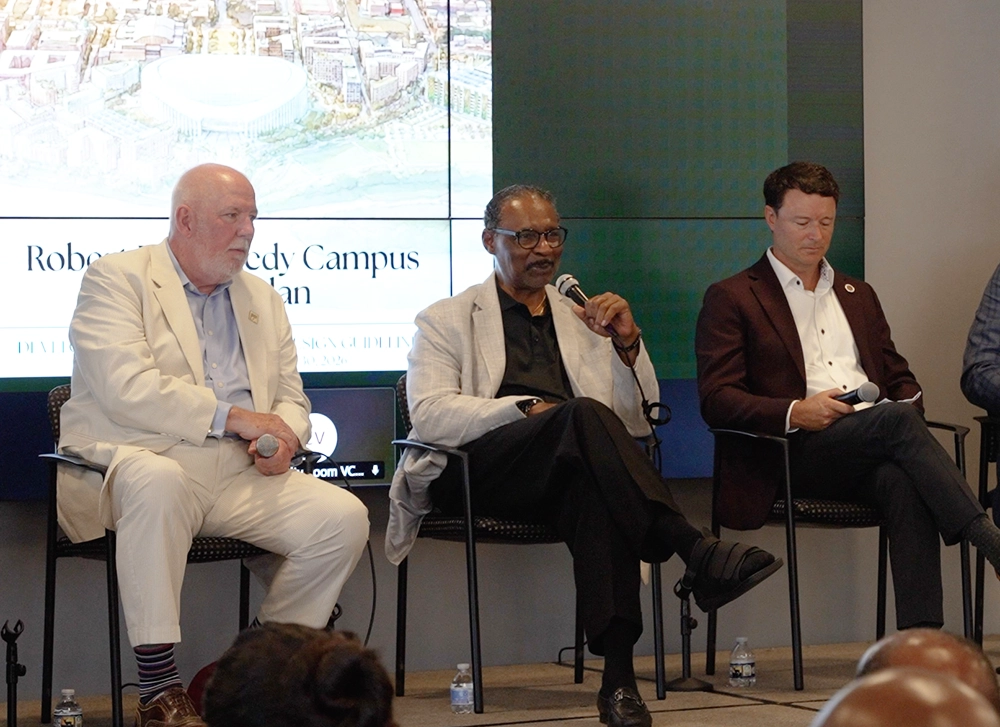
Anacostia Economic Development Corporation President Stanley Jackson, center, addresses the panel audience. On the left in the photo is Brian Hanlon, project executive and Director of the D.C. Department of Buildings. On the right is Washington Commanders’ Head of Construction Matt Haas. Photo: Michael Blain
The project’s scope is immense, representing a total investment of $3.7 billion by the District. The Washington Commanders have committed at least $2.7 billion in private investment to cover the full cost of the stadium’s construction.
The roughly 65,000-seat roofed facility is scheduled for a groundbreaking in March 2027 and is expected to open its doors in 2030. Beyond the physical structure, the project will be a jobs engine, estimated to create approximately 14,000 stadium construction jobs and 2,000 permanent positions, with on-site construction forces peaking at roughly 2,300 workers daily.
A foundational element of the development is a Project Labor Agreement (PLA) that will cover both the stadium and surrounding hotel and restaurant districts. The PLA will ensure high labor standards, reliable access to skilled labor throughout the project and career opportunities for city residents.
“Project labor agreements are key to ensuring District residents get good jobs, family-sustaining wages and benefits, and access to workforce development opportunities.”
– Greg Akerman, President
Baltimore-DC Metro Building Trades Council
“Project labor agreements are key to ensuring District residents get good jobs, family-sustaining wages and benefits, and access to workforce development opportunities.”
– Greg Akerman, President
Baltimore-DC Metro Building Trades Council
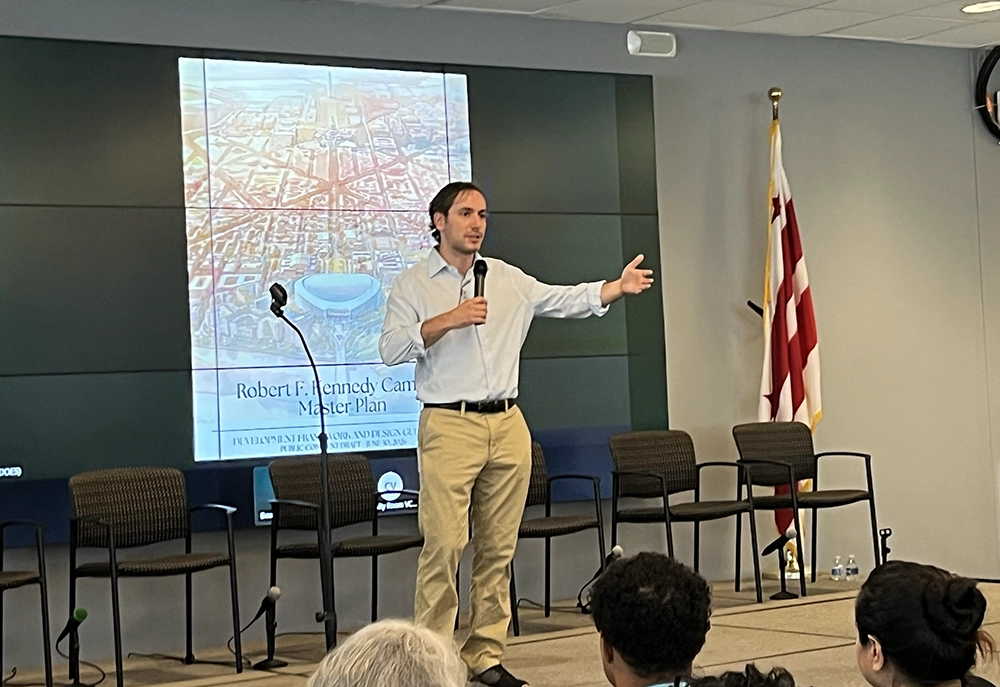
Baltimore-DC Metro Building Trades Council President Greg Akerman addresses the audience at the July 22 panel discussion. Photo: Michael Blain
“Project labor agreements are key to ensuring District residents get good jobs, family-sustaining wages and benefits, and access to workforce development opportunities,” said Baltimore-D.C. Metro Building Trades Council President Akerman at the event.
The PLA and associated city requirements establish aggressive goals for local hiring and small business participation. While public funds typically require a 40% expenditure target for Certified Business Enterprises (CBEs), the RFK project aims for 50% CBE participation.
Matt Haas, the Commanders’ Head of Construction, made it clear that local building trades partners are essential to the team’s success on the project, noting that without signatory contractors and union trades partners, big projects like this “just don’t get done.”
“So, you’re the lifeblood,” he added. “We can’t wait to work closely with you here going forward.”
Building trades unions are committing to ensure that 51% of all new hires on the project are D.C. residents, with a preference given to residents of Wards 7 and 8. Apprenticeship opportunities are also mandated under the PLA, which also requires a minimum of 10% D.C. resident participation, with an ultimate goal of reaching 35%.
Clark Construction Vice President Ben Eitan emphasized that safety would be a top priority on the project: “It’s going to be paramount. It is the most important thing we’re going to think about.”
“At every level within the trades,” added Eitan, “it’s going to be about what’s the plan to bring the necessary skilled, trained, safe labor to the job site to execute and have the right management and supervision to support that.”
The redevelopment extends far beyond the stadium walls, to the surrounding 180-acre campus. Plans include the creation of 5,000 to 6,000 housing units — at least 30% are slated to be affordable housing — and a $77 million Sportsplex featuring potential amenities like an indoor track and indoor swimming pools.
“It is a singular opportunity to transform how we work in the city.”
– Brian Hanlon, Project Executive and Director
D.C. Department of Buildings
“It is a singular opportunity to transform how we work in the city.”
– Brian Hanlon, Project Executive and Director
D.C. Department of Buildings
The site will be organized into distinct districts, such as the mixed-use Plaza District near the Metro, and a Riverfront District focused on residential space and river access. The project also includes a comprehensive energy master plan to explore sustainable infrastructure like geothermal and solar power.
Reflecting on the long-term impact of the redevelopment, Brian Hanlon, project executive and Director of the D.C. Department of Buildings, framed the project as a historical turning point for the city.
“It is a singular opportunity to transform how we work in the city,” Hanlon said. “I think 10 or 15 years from now, there will be ongoing ripple effects of what we’re talking about here today that are because of what we’re doing here today.”