

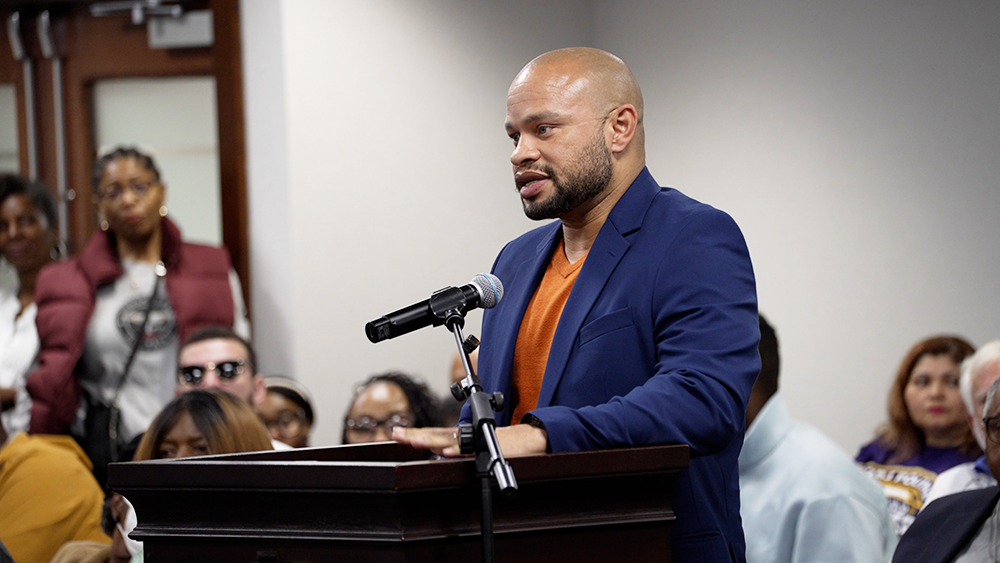
ABOVE: Britton Loftin, a representative with International Union of Painters and Allied Trades (IUPAT), speaks at the Sept. 22 Prince George’s County Council listening session. Photo: Michael Blain.
The Prince George’s County Council hosted a packed community “listening session” earlier this week to discuss the proposed Sphere at National Harbor. Turnout was so high that officials had to open an overflow room to accommodate all the residents and workers eager to speak.
When opening the session, Council Chair Krystal Oriadha clarified that the event was a non-voting session rather than an official council meeting where any formal votes would be taken. She then emphasized that any development of this scale must center on the needs of county residents and workers.
Miss the listening session? Join us in Fort Washington the evening of Sept. 24 for a Worker & Resident Town Hall re: the Sphere at National Harbor. Learn more >
“When you’re talking about billions of dollars being spent,” she said, “we want to make sure that we’re elevating locally owned and operated businesses and centering our minority businesses.”
“We also want to make sure,” she added, “that our labor partners have a seat at the table,” emphasizing that “if we’re committing a dollar of revenue from the taxpayers that we’re doing it thoughtfully.”
The council is considering a proposal that would include around $200 million in public support, anchored around a $130 million a Tax Increment Financing (TIF) package.

An artist’s rendering of the proposed Sphere at National Harbor.
Trades Call for Mandatory PLA
The Baltimore-DC Metro Building Trades Council is urging the county to require a Project Labor Agreement (PLA) before approving any public funds. During testimony, numerous union members argued that a binding PLA is the only way to guarantee prevailing wages, local hiring targets and registered apprenticeship opportunities for county residents.
Additional Carpenters’ Union members highlighted local school construction projects as proof that PLAs deliver results for local workers.
“For me, this is more than just another construction project,” said David Washington, a journey-level carpenter who worked on Templeton and Fairwood Elementary Schools under a PLA. “It allows me to earn good wages, provide for my family and work in the same community where I live.”
“Those PLAs help create a pathway for me to go from CTE classroom into a registered apprenticeship… I am living proof of what can happen when CTE, registered apprenticeships and PLA job opportunities are connected.”
– Ashton Adams, First-Year Apprentice
Carpenters’ Union
“Those PLAs help create a pathway for me to go from CTE classroom into a registered apprenticeship… I am living proof of what can happen when CTE, registered apprenticeships and PLA job opportunities are connected.”
– Ashton Adams, First-Year Apprentice
Carpenters’ Union
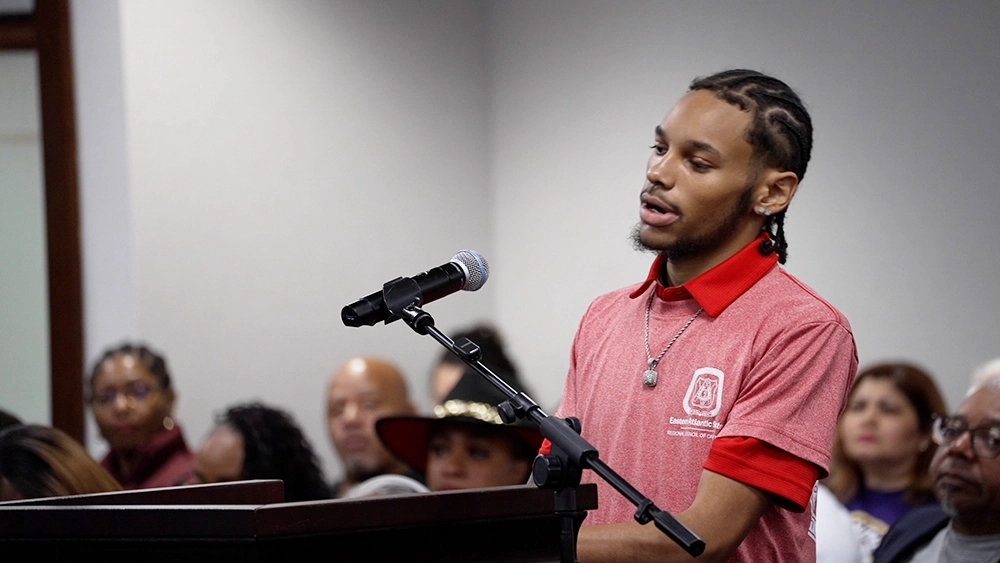
Ashton Adams, a first-year apprentice with the Carpenters’ Union, speaks at the Sept. 22 Prince George’s County Council listening session. Photo: Michael Blain.
Ashton Adams, a 19-year-old first-year apprentice and Crossland High School CTE graduate who worked on Templeton and Robert Frost Elementary Schools, noted: “Those PLAs help create a pathway for me to go from CTE classroom into a registered apprenticeship… I am living proof of what can happen when CTE, registered apprenticeships and PLA job opportunities are connected.”
Hospitality and service workers represented by UNITE HERE also called for binding labor protections.
“We’re here to support a PLA and a labor peace agreement,” said Margaret Sharp, an Organizing Director with UNITE HERE Local 23. “I’m glad to hear that the Sphere has a positive relationship with unions. And, in that case, it should be no problem to have these agreements in place before there’s any TIF financing.”
Representing the developer, Paul Macchia, Senior Vice President of Government Affairs and Social Impact for Sphere Entertainment, detailed the project’s scope — a $1.4 billion, 6,000-seat venue expected to generate $1.3 billion in annual local economic activity and over $60 million in annual county tax revenue.
Addressing union concerns, Macchia underscored the company’s resistance to signing a mandatory PLA in Prince George’s County. He claimed that “all of the companies in the Madison Square Garden family of companies, including Sphere Entertainment, are exceptionally union friendly.” He noted that during the construction of the Las Vegas Sphere, “over 97% of the full-time employees on that project were union members, without a PLA.”
Union speakers pushed back on non-binding assurances, arguing that formal agreements are necessary to protect local labor standards.
Lamar Mutts, a Representative for the Eastern Atlantic States Regional Council of Carpenters, directly challenged the developer: “MSG and Sphere Entertainment: If you want to be our partner, then be a partner. Invest in Prince George’s County contractors, workers and young people and put that commitment in a PLA.”
Vegas Sphere Faced Millions in Wage Complaints
Beyond wage and hiring commitments, union advocates pointed to past contractor issues in Nevada as a key reason for establishing binding rules early in the process.
Mutts from the Carpenters’ Union noted that “public records from Las Vegas Sphere show that 14 contractors became involved in payment-related claims and disputes involving millions of dollars.”
While acknowledging that MSG has disputed those claims, Mutts stressed that “when that many contractors are involved, it raises legitimate questions and concerns,” arguing that a binding PLA is needed up front so local workers, responsible contractors and workforce groups are fully protected before ground is broken.
Building trades workers also emphasized that public investments must help build long-term middle-class careers.
“By attaching prevailing wage, registered apprenticeship programs and local hire guarantees to this TIF,” said Britton Loftin, a Representative with the International Union of Painters and Allied Trades (IUPAT), “you protect taxpayers, ensure top-tier safety and efficiency, and guarantee local workers build this project.”
Retired glazier Carl Paige of IUPAT Local 963 concluded: “It is my hope and my prayer that the Sphere at National Harbor will create meaningful opportunities for this next generation of skilled tradespeople here in Prince George’s County.”
“By attaching prevailing wage, registered apprenticeship programs and local hire guarantees to this TIF, you protect taxpayers, ensure top-tier safety and efficiency, and guarantee local workers build this project.”
– Britton Loftin, Representative
International Union of Painters and Allied Trades (IUPAT)
“By attaching prevailing wage, registered apprenticeship programs and local hire guarantees to this TIF, you protect taxpayers, ensure top-tier safety and efficiency, and guarantee local workers build this project.”
– Britton Loftin, Representative
International Union of Painters and Allied Trades (IUPAT)
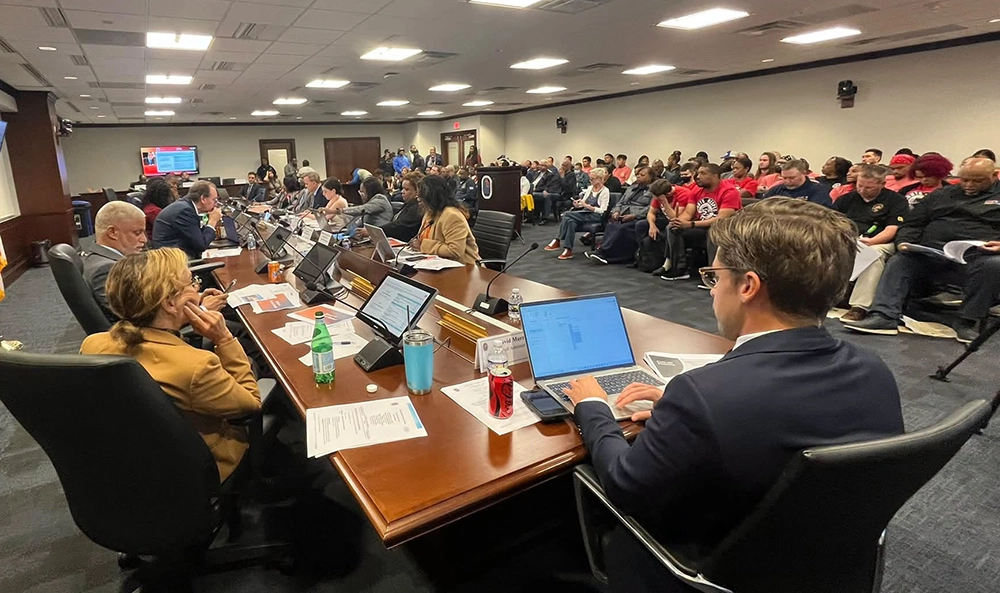
It was a packed house at the Sept. 22 Prince George’s County Council “listening session” about the proposed Sphere at National Harbor. Photo: Michael Blain.
16K LED Screen, 4D Sensory Effects
The proposed venue would sit on a 15-acre campus just north of MGM National Harbor, standing 302 feet tall and featuring a 16K LED screen covering 2.5 acres, 4D sensory effects and a fully customizable exterior exosphere. It would also include “beam-forming sound” — an audio technology that directs precise beams of sound to specific seats or sections rather than broadcasting audio broadly across the entire venue.
Estimates predict the project will generate 3,300 local construction jobs and 7,000 operational jobs, with site work anticipated for December 2026, leading to a spring 2030 grand opening.
Addressing confusion over earlier media advisories indicating a potential vote on September 29, Council Chair Oriadha clarified that no final vote will occur next week. Instead, the legislation moves first to the Planning, Housing, and Economic Development (PED) Committee for further review, followed by another formal public hearing before the full council, with a final vote expected in October at the earliest.