

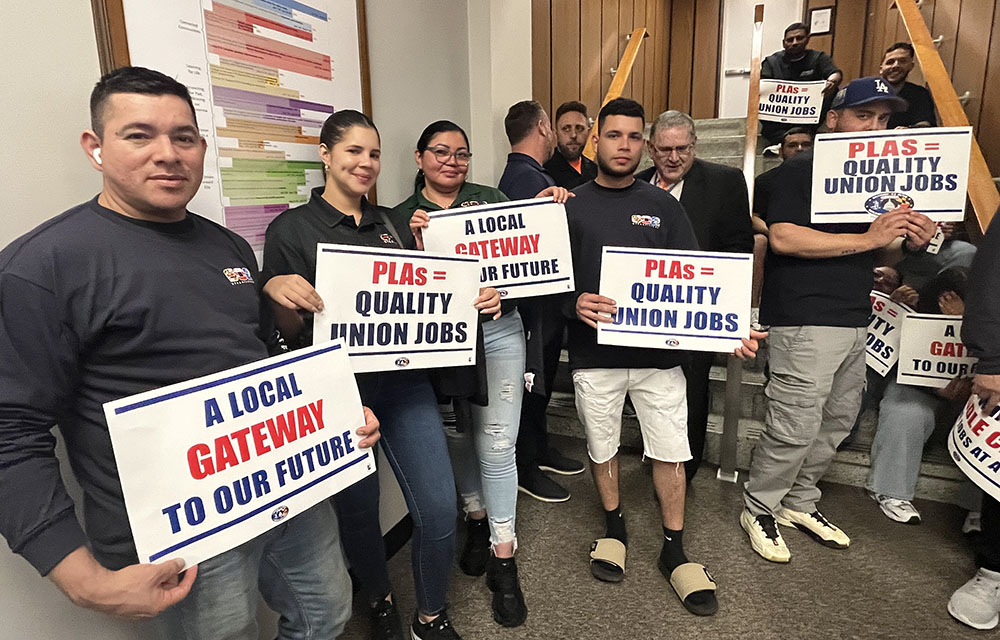
ABOVE: Members of Plumbers and Steamfitters Local 602 turned out to show their support for the 1500 Gateway project at the Aug. 25 Fredericksburg City Council meeting. Photo: Michael Blain.
In a unanimous 7-0 vote early Wednesday, the Fredericksburg City Council denied a zoning map amendment and special use permit for the proposed 1500 Gateway data center project.
The project would have built a two-building, 1-million-square-foot campus adjacent to I-95. The developer – 1500 Gateway LLC, an affiliate of Penzance – had agreed to implement a Project Labor Agreement (PLA), prioritizing local hiring and guaranteeing thousands of good jobs for area residents. In addition, the developer had committed to contribute $20 million to Fredericksburg schools over the next 20 years.
Projections estimated that 1500 Gateway would have created more than 2,800 union construction jobs, generating over $190 million in wages. It was also projected to generate over $23 million in annual tax revenue for the city.
Projections estimated that 1500 Gateway would have created more than 2,800 union construction jobs, generating over $190 million in wages.
Projections estimated that 1500 Gateway would have created more than 2,800 union construction jobs, generating over $190 million in wages.
Sticking to the Existing Technology Overlay District (TOD)
Although the project offered significant economic benefits for the city and its residents, several councilmembers said just ahead of their vote that they felt bound by the Technology Overlay District (TOD), which was debated and approved by the council in 2025. The proposed Gateway project was outside that district, but would have been built on land already zoned “Planned Development-Medical Center,” for a proposed Veterans Affairs clinic that ultimately was not built on the site.
Council Was Moved by Worker Testimony
The public hearing featured powerful testimony from local union members and leaders, as well as from other workforce advocates. Several councilmembers explicitly expressed their appreciation and respect for these worker voices, even as they voted to deny the zoning exemption.
Much of the building trades testimony underscored how jobs under Project Labor Agreements represent crucial pathways to the middle class.
“Having local projects is really, really important…This is the ability to actually create meaningful middle-class jobs in the region.”
– Greg Akerman, President
Baltimore-DC Metro Building Trades Council
“Having local projects is really, really important…This is the ability to actually create meaningful middle-class jobs in the region.”
– Greg Akerman, President
Baltimore-DC Metro Building Trades Council
Greg Ackerman, President of the Baltimore-DC Metro Building Trades Council, urged the council to value these local opportunities.
“Having local projects is really, really important,” he said. “It’s going to create an apprentice who can then market themselves to go work on other projects, who then has the money to be able to buy a car to go work regionally. And so these are not just temporary construction jobs…This is the ability to actually create meaningful middle-class jobs in the region.”
Proponents also emphasized what the landmark PLA would have achieved, and how responsive the developer had been to community concerns:
- Virginia Diamond (Northern Virginia AFL-CIO): She described the PLA as “historic and unprecedented” and an agreement that would “lift hundreds and thousands of residents into the middle class.”
- Roberto Gomez (Workforce development professional): “Behind every major construction project are [skilled professionals] who actually build it… Talent is everywhere. Opportunity is not.”
- Lupe Trejo (Steamfitters Local 602): She shared how a zero-tuition union apprenticeship “changed the trajectory of my life and the life of my children.”
- Don Slaiman (IBEW Local 26): He highlighted the opportunity “to make sure that people can have careers that are sustainable.”
- Jason Friedman (Carpenters Union): He noted how the developer had “heard the concerns… and adjusted their project to be really remarkable.”
Developer Revisions and Responsiveness
Councilmembers praised developer Penzance for its responsiveness to community concerns and feedback. The company overhauled its original plan by cutting the campus size in half to 1 million square feet, moving generators to the I-95 side, dedicating 44% of the site to open space, pledging up to $40 million in cash proffers to the city, and adopting a pioneering 100% air-cooled design using zero cooling water.
Despite these concessions, many councilmembers still said the fact that the project was outside the TOD was a deal-breaker for them.
A Policy Breakthrough for Future PLAs in the City?
Although the zoning amendment was denied, effectively closing the door on the project, public discussion of the proposal and this week’s hearing may have seeded a policy shift inside the Fredericksburg City Council, with multiple councilmembers vowing to support PLAs on future projects. Many also said they learned a lot in recent months about unions in general and the building trades in particular.
Councilmember Jannan Holland committed to “discussing ways that Fredericksburg can support union work,” while Councilmember Susanna Finn called PLAs “an opportunity that we need to more sincerely advocate for.” Vice Mayor Chuck Frye, a 25-year Teamster, urged his colleagues to help local workers find family-sustaining careers.
Mayor Kerry Devine closed out the hearing by promising that the council would not let the PLA issue fade away: “Vice Mayor Frye has been pushing the project labor agreement… we’re not gonna let that die.”