

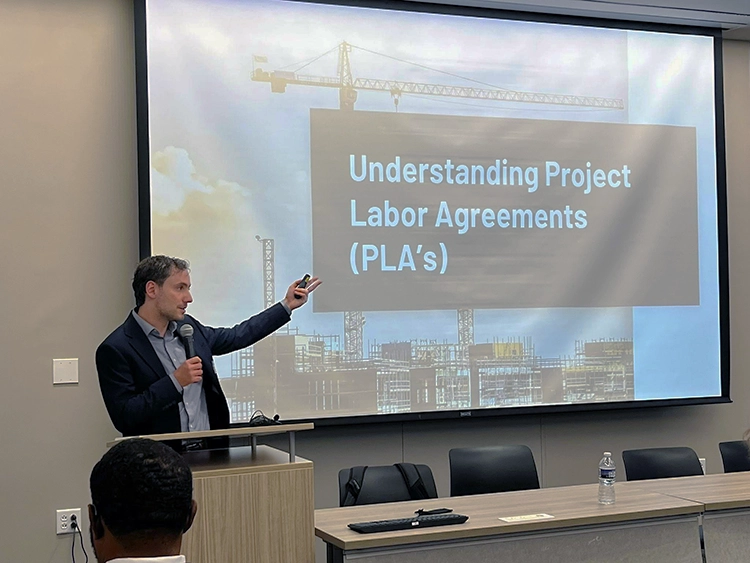
It was a packed house last Thursday evening for a Project Labor Agreement Roundtable discussion at the D.C. Department of General Services (DGS) headquarters in Ward 7.
DGS officials, building trades representatives and signatory contractors provided an overview of current and upcoming DGS PLA projects and outlined the benefits of PLAs for contractors, workers and local communities. They also addressed some concerns and myths about PLAs and took questions from the audience.
The current PLA threshold in the District is $50 million for public construction projects, a decrease from the previous $75 million threshold. The change to lower the threshold for mandatory PLAs was enacted by the D.C. Council in August 2024 and went into effect for fiscal year 2026, which began on Oct. 1, 2025.
“Tonight is about information sharing and ensuring that our general contractors, our subcontractors and our trades professional have the knowledge and resources that we all need…”
– D.C. Department of General Services (DGS) Director Delano Hunter
“Tonight is about information sharing and ensuring that our general contractors, our subcontractors and our trades professional have the knowledge and resources that we all need…”
D.C. Department of General Services (DGS) Director Delano Hunter
“Tonight is about information sharing and ensuring that our general contractors, our subcontractors and our trades professional have the knowledge and resources that we all need to navigate this new requirement,” said D.C. Department of General Services (DGS) Director Delano Hunter.
“It’s also about our partnership,” he added. “When government, labor and industry come together with clarity and collaboration, we survey our entire ecosystem.”
PLAs typically include:
- Standardized working conditions across trades.
- A streamlined process for resolving jurisdictional disputes.
- Requirements to pay specific wage rates on public works projects.
- Requirements for hiring workers through union hiring halls.
- Prohibitions on strikes and lockouts.
- Prohibitions on discrimination.
“A PLA is a one-time collective bargaining agreement that covers the wages and terms and conditions of a particular construction project,” Baltimore-DC Building Trades Council President Greg Akerman explained during his presentation.
Key benefits of PLAs, he said, include:
- Increased productivty, with projects more likely to be completed on-time and on-budget.
- Better organized projects, which helps avoid costly delays by enabling better workforce coordination.
- The spurring of economic growth, job creation and career opportunities for local residents, which in turn grows the local tax base.
Because building trades unions have robust training and apprenticeship programs, said Akerman, PLAs also offer opportunities for contractors to grow their businesses and “to have access to a whole other workforce pipeline that they may not already have access to.” In this way, he said, PLAs can enable them to bid on bigger and more complex projects.
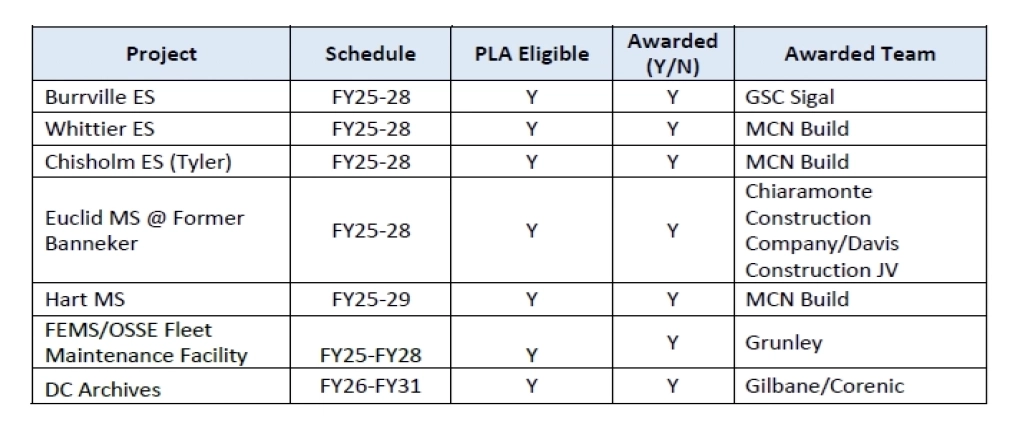
DGS Interim Director of Capital Construction Osei Headley provided an overview of projects in which DGS is a party to a PLA. Referring to a chart he was presenting on-screen, he said “we have many more PLA agreements than we have had in the past, as evidenced by the seven jobs that are in the first column.”
Current DGS Project Labor Agreements
Headley also offered details about four future DGS PLA projects that will be solicited in the coming year.
Future DGS Project Labor Agreements
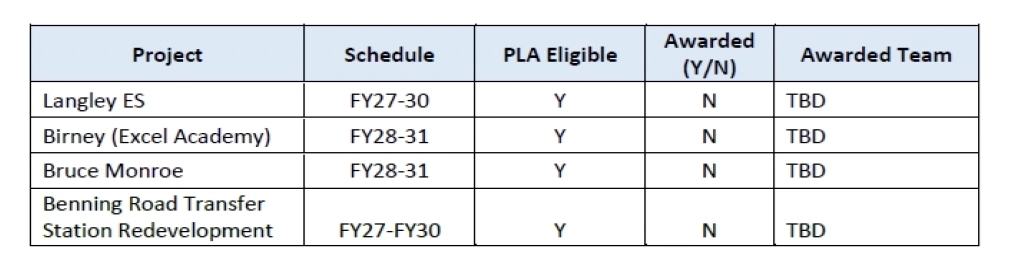
The Langley Elementary School project, he said, will be a renovation and modernization of an historic school building and will include a child development center, new classroom spaces and an expanded gymnasium.
The Birney project, he added, will be a “full ground-up modernization” on a tight site, which will make it both challenging and “an exciting project to work on.”
Like Langley E.S., Headley said, the Bruce Monroe project will be a renovation and modernization of an existing historic school building and site. It will include small additions, new classroom spaces, an expanded gymnasium and an expanded kitchen.
In addition to the DGS PLA projects, the $3.7 billion RFK Stadium redevelopment is another large District project that will be under a project labor agreement. In addition to stadium construction, that PLA will also cover new development on adjacent parcels, as well as post-construction jobs in stadium concessions, security, janitorial and hospitality work at hotels in those parcels. DGS is not a party to that PLA.
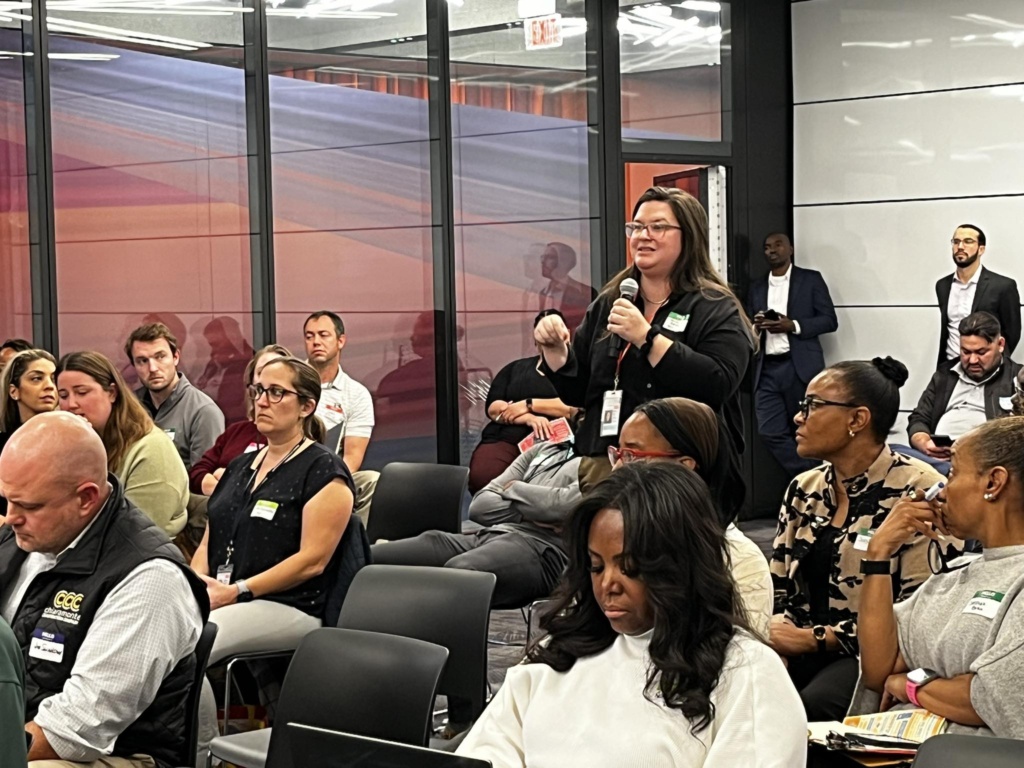
An audience member asks a question of the panel during the Nov. 6 PLA roundtable. Photo: Michael Blain
During presentations and an audience Q&A, a number of concerns about PLAs were addressed, including the idea that PLAs prohibit non-union contractors from bidding on a project. The reality, said Akerman, is that all contractors, union or non-union, can bid on projects with PLAs.
Akerman outlined several other “myths” about PLAs, including:
MYTH: PLAs discriminate against minorities and minority-owned contractors.
REALITY: All contractors, including minority-owned contractors, can bid on PLA projects. PLAs prevent wage disparities that otherwise exist for minorities and women by standardizing wages and benefits for all workers. PLAs also contain grievance procedures for harassment and discrimination, meaning workers who experience any abuses have a simple, effective mechanism to resolve issues. PLAs also oftentimes contain local hire provisions that target underserved communities, creating career opportunities for disadvantaged residents.
________
MYTH: PLAs increase the cost of doing business, including the cost of doing business for small and minority-owned businesses.
REALITY: PLAs level the playing field by standardizing wages, benefits, and working conditions – and stabilize costs for owners by ensuring access to qualified labor throughout the duration of a project.
________
MYTH: PLAs make it impossible to lay off unqualified workers.
REALITY: There is nothing stopping a contractor from laying off workers under a PLA.
Speaking to contractors in the room, Akerman said: “We go out of our way to make this stuff as simple as possible for you. We want to stress that we’re always a resource. Not just myself, but our affiliate unions are always a resource to try and help folks deal with any of this.”
“If you have any questions or concerns about PLAs,” he concluded, “we very much we encourage you to reach out to us.”
Visit BDCBT.org to contact building trades council leadership.