

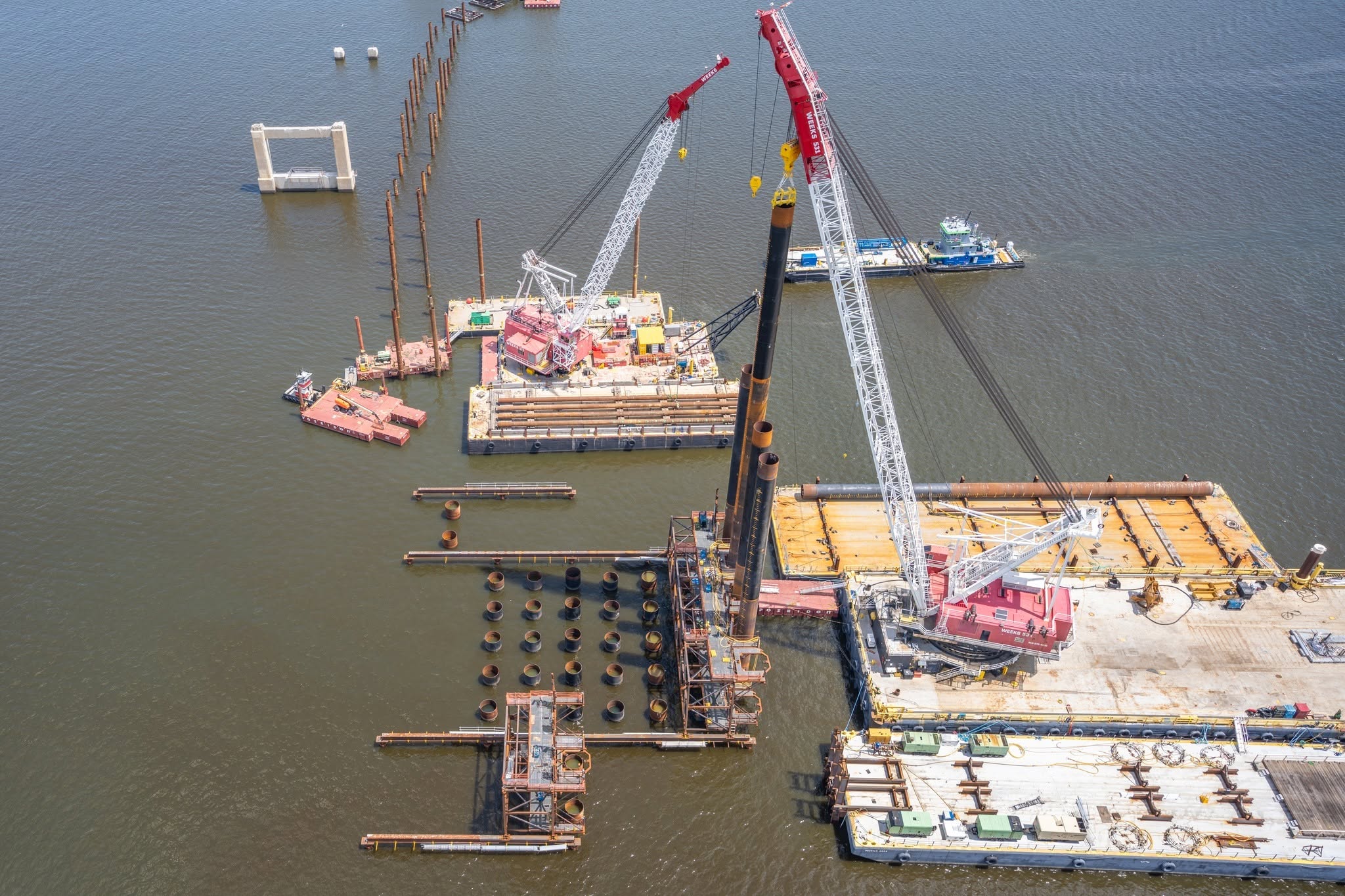
PHOTO: Maryland Transportation Authority.
The Maryland Transportation Authority (MDTA) has officially opened competitive bidding for the “Demolition and Miscellaneous Marine Work” contract on the rebuild of the Francis Scott Key Bridge, marking the launch of the second phase of the massive project.
Announced on August 25, 2026, the sealed bidding process aims to keep the reconstruction on an aggressive timeline by preparing to clear remaining structures over the Patapsco River while current foundation construction continues. The second phase will run parallel to active construction, ensuring that clearing old debris does not impede the forward momentum of the new bridge.
As the project advances, the Baltimore-DC Metro Building Trades Council and local building trades affiliates are actively pushing for a Project Labor Agreement (PLA) to cover all remaining phases of the rebuild.
“Project Labor Agreements are the best way to ensure that this rebuild is both an investment in the bridge and the people who build it — creating high-quality jobs and life-changing career opportunities for local residents.”
– Greg Akerman, President
Baltimore-DC Metro Building Trades Council
“Project Labor Agreements are the best way to ensure that this rebuild is both an investment in the bridge and the people who build it — creating high-quality jobs and life-changing career opportunities for local residents.”
– Greg Akerman, President
Baltimore-DC Metro Building Trades Council
Emphasizing the community impact of such an agreement, Baltimore-D.C. Metro Building Trades Council President Greg Akerman stated: “Project Labor Agreements are the best way to ensure that this rebuild is both an investment in the bridge and the people who build it — creating high-quality jobs and life-changing career opportunities for local residents.”Under Governor Wes Moore’s 2023 Executive Order 01.01.2023.22, state agencies are authorized to consider PLAs for public works projects exceeding $20 million
MDTA officials have previously stated they were evaluating the contracts for possible PLAs to ensure workforce development compliance, which aims to support local hiring, promote safety and create stable labor conditions.
The overall Key Bridge rebuild is a staggering engineering and financial endeavor, totaling approximately 11,000 feet of construction along the I-695 Baltimore beltway. At its center is a new 1,665-foot main span cable-stayed bridge soaring over the federal navigational channel, with a total cable-stayed length of 3,365 feet supported by iconic, 602-foot-tall H-shaped concrete pylons. The total rebuild cost is projected to range between $4.3 billion and $5.2 billion.
The newly advertised Phase 2 contract specifically covers the removal and salvage of steel girder spans, the demolition of marine and land piers, sub-aqueous foundation demolition and the clean-out of 96-inch steel pipe piles. Bids for this portion are due in Fall 2026, with demolition work expected to begin in late 2026.
Meanwhile, foundation work remains on-track and on-budget, with 80 of the 90 massive foundation piles already driven into the riverbed.
Although much of the current pile-driving happens underwater, the public can expect to see highly visible progress on land by next summer as construction of the main bridge span begins, heading toward an overall completion date in late 2030.