

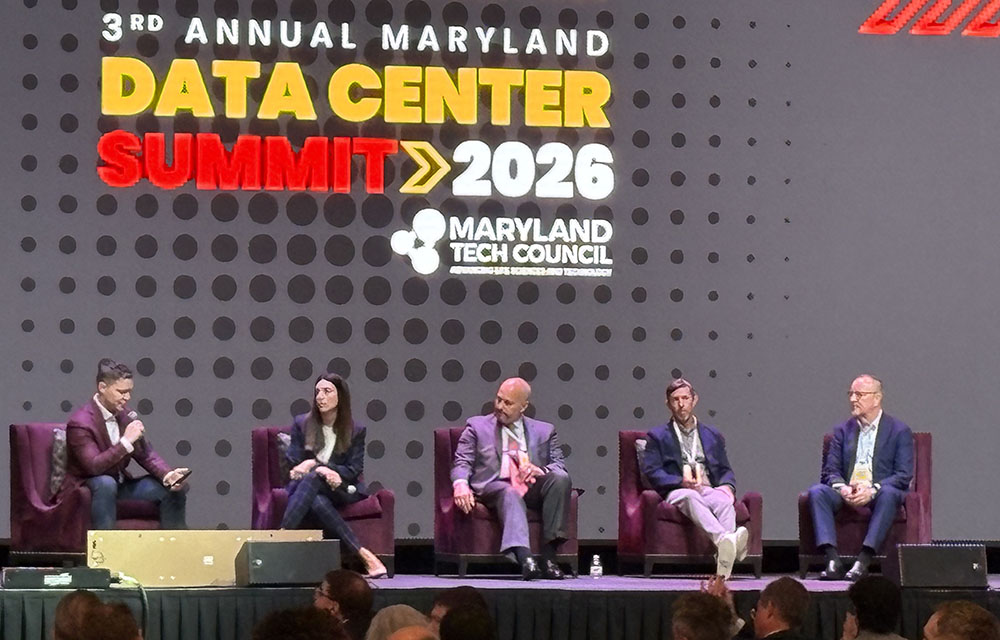
ABOVE: Jason Friedman (center), a Senior Council Representative for the Eastern Atlantic States Regional Council of Carpenters, participates in a panel discussion at the 2026 Maryland Data Center Summit.
When it comes to the future of the digital economy, Mid-Atlantic building trades unions have a shared message: We cannot afford to sit on the sidelines while tomorrow’s infrastructure is being discussed and mapped out. To help shape the future, the trades need to be in the rooms where conversations are happening and decisions are being made.
This strategic approach was on full display at the Maryland Data Center Summit last week. Rather than watching from afar, building trades unions were out in force at the summit. From exhibition booths to panel discussions, representatives from the Carpenters’ Union, IBEW Local 24 and Plumbers and Steamfitters Local 486 made sure organized labor was an active participant in the event.
“An obvious reason we want to be involved is it’s putting lots of our members to work,” said Local 486 Business Agent Chris Anderson, noting that data centers are already a massive jobs engine for union members.
Local 486 sent six people to staff its booth and represent the union at the summit — including members working on active data center projects in Frederick, Md., and HVAC service technicians specializing in complex, closed-loop chiller systems.
“You want to be in the forefront of the next generation of this digital infrastructure. And we want to be the ones building it.”
– Chris Anderson, Business Agent
Plumbers and Steamfitters Local 486
“You want to be in the forefront of the next generation of this digital infrastructure. And we want to be the ones building it.”
– Chris Anderson, Business Agent
Plumbers and Steamfitters Local 486

Staff and members of Plumbers and Steamfitters Local 486 at their booth at the 2026 Maryland Data Center Summit.
Why Organized Labor Must Be at the Table
For building trades leadership, participating in tech industry events is not optional — it is key to ensuring union labor remains the standard for next-generation construction.
“You want to be in the room,” said Anderson, “so you’re not left behind.” He emphasized that with over 350 Local 486 members currently working on data center projects in Frederick and “really no end in sight,” the building trades must remain highly visible partners in these industry discussions.
“You want to be in the forefront of the next generation of this digital infrastructure,” he added. “And we want to be the ones building it.”
Jason Friedman, Senior Council Representative for the Eastern Atlantic States Regional Council of Carpenters, echoed this sentiment. He described organized labor as a fundamental part of the team needed to make these projects a reality.
“We’ve got a role to play. We’re experts in workforce development and training.”
Jason Friedman, Sr. Council Representative
Eastern Atlantic States Regional Council of Carpenters
“We’ve got a role to play. We’re experts in workforce development and training.”
Jason Friedman, Sr. Council Representative
Eastern Atlantic States Regional Council of Carpenters
“We’ve got a role to play,” Friedman said. “We’re experts in workforce development and training,” he added, emphasizing that building trades unions bring unmatched expertise in recruiting, training and dispatching of skilled manpower.
“We should not abdicate those responsibilities,” he added. “We should not walk away from them. We should step up and let folks know what we have to offer.” By attending such events, he said, labor leaders also gain a firsthand understanding of emerging industry trends, helping them to proactively prepare members for upcoming project pipelines.
Driving the Conversation From the Stage
Beyond their exhibition booths, building trades representatives actively engaged in featured panel discussions during the summit.
Friedman participated in a panel focused on workforce development, titled “From Construction to Operations: The Jobs Behind Digital Infrastructure.” During his session, he delivered a candid warning to developers about the unique labor demands of “hyperscale” facilities.
“With these projects at the scale and the velocity they are intending to move at,” Friedman cautioned, “labor can’t be taken for granted.”
He urged developers to move past business-as-usual approaches, stating: “Developers shouldn’t be trying to staff these jobs like they’re a multifamily residential project or a strip mall.” Instead, he emphasized that successful, mishap-free project completion requires early, transparent communication and coordination with organized labor.
Similarly, IBEW Local 24 Business Agent Carmen Voso represented the building trades on a panel titled “Growth, Revenue, and Responsibility: The Maryland Policy Conversation on Data Centers.” His remarks at the summit underscored how these massive projects translate into life-changing economic opportunities for local workers.
“I think the biggest impact of data centers in Maryland is launching a lot of people into the middle class.”
Carmen Voso, Business Agent
IBEW Local 24
“I think the biggest impact of data centers in Maryland is launching a lot of people into the middle class.”
Carmen Voso, Business Agent
IBEW Local 24
“I think the biggest impact of data centers in Maryland is launching a lot of people into the middle class,” said Voso.
He also challenged the claim that data centers only generate short-term, temporary employment, pointing out that data center construction provides long-term, stable careers.
“A 25-year career is not a temporary job,” he said, sharing that his union career has provided him with a secure pension and quality healthcare for his family.
Building the Digital Future
The summit took place at a time when some local and county governments are pausing zoning or building permits for data center projects, or considering moratoriums on such projects.
As community and political debates over data center development heat up, one message from the 2026 Maryland Data Center Summit was clear: You cannot build the digital future without organized labor. By securing a seat at the table, Mid-Atlantic building trades unions are working to ensure that the region’s digital economy is built safely, efficiently, and with highly skilled local union labor.