

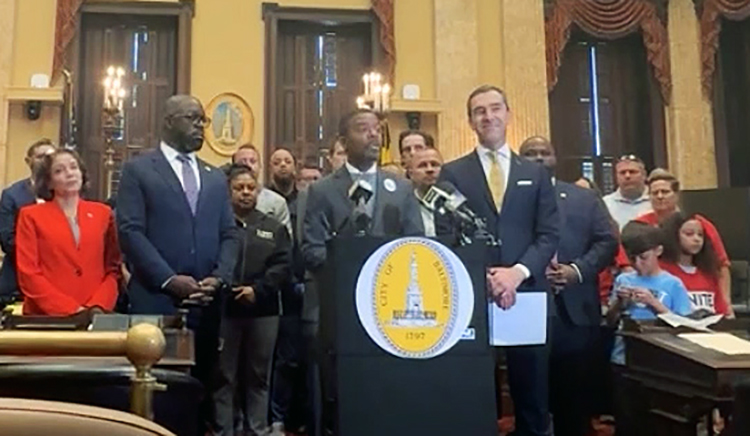
Last night, the Baltimore City Council voted unanimously, 14-to-0, to approve a plan aimed at expanding and strengthening workers’ rights in the city.
The council resolution, titled “Workers’ Rights in Baltimore City,” was backed by the Baltimore-DC Metro Building Trades Council, the AFL-CIO and other unions, including SEIU 32BJ.
“This resolution makes one thing clear: Baltimore is a workers’ city and a union town,” said Metro Baltimore Council AFL-CIO President Courtney Jenkins at a press conference earlier in the day.
“It affirms,” he added, “that every worker has a right to safe working conditions, fair and livable wages, privacy and dignity in the workplace, education and training opportunities, work/life balance, and the ability to participate fully in our democracy. These are not just privileges. They are basic rights, and upholding them strengthens our city as a whole.”
“This resolution makes one thing clear: Baltimore is a workers’ city and a union town.”
– Metro Baltimore Council AFL-CIO President Courtney Jenkins
“This resolution makes one thing clear: Baltimore is a workers’ city and a union town.”
– Metro Baltimore Council AFL-CIO President Courtney Jenkins
City Council President Zeke Cohen said the council will be introducing a number of bills in coming months aimed at addressing specific labor and workplace issues.
“The city council and our partners in labor will make Baltimore the best city in America for working people,” said Cohen.
“Baltimoreans deserve to know,” he added, “that when they leave for work in the morning, they’ll come back home at night without risking life… Baltimoreans deserve the right to organize because we know that the only thing better than a good job is a good union job.”
At the press conference, Cohen and other speakers underscored that arguments claiming you can either be pro-labor or pro-business, but not both, set up a false choice.
“In the building trades, we know that well,” said Ray Baker, Maryland Director of the Baltimore-DC Metro Building Trades Council. “Because our highly skilled, highly trained workers get jobs done on-time and on-budget.”
In a city as diverse as Baltimore, he added, unity of purpose will be essential to strengthening workers’ rights.
“Solidarity will be the key,” said Baker. “But we cannot have solidarity unless we all are pulling in the same direction. Workers of Baltimore, come join with us. Pull with us. Let us get where we need to go.”
Baltimore City Councilmember Jermaine Jones said that strengthening workers’ rights has positive, community-wide impacts that ripple out across a city.
“Work is what affects every household, every child,” said Jones. “If you want to lower crime, you give someone a job. Crime is the byproduct of people not having good wages, opportunities or benefits.”
“If we want to better our education system,” he added, “we need to make sure we have our children coming home to homes where their parents don’t have to work two or three jobs, where they have time to sit down with them to do their homework.”
“Work is what affects every household, every child. If you want to lower crime, you give someone a job. Crime is the byproduct of people not having good wages, opportunities or benefits.”
– Baltimore City Councilmember Jermaine Jones
“Work is what affects every household, every child. If you want to lower crime, you give someone a job. Crime is the byproduct of people not having good wages, opportunities or benefits.”
– Baltimore City Councilmember Jermaine Jones
The resolution also has language articulating workers’ rights to privacy and dignity in the age of AI, the right to organize and collectively bargain without retaliation, and the right to family/life and work/life balance. View the full resolution >
“We should be proud that Baltimore is a union town through and through,” said City Union of Baltimore President Antoinette Ryan Johnson, whose union represents city employees and Baltimore City Public Schools workers.
“For those bosses and employers and politicians,” she added, “who would spend their vast resources and powers to deny and crush their employees’ effort to create a more democratic workplace, let us say to you today: Not in our Baltimore.”