

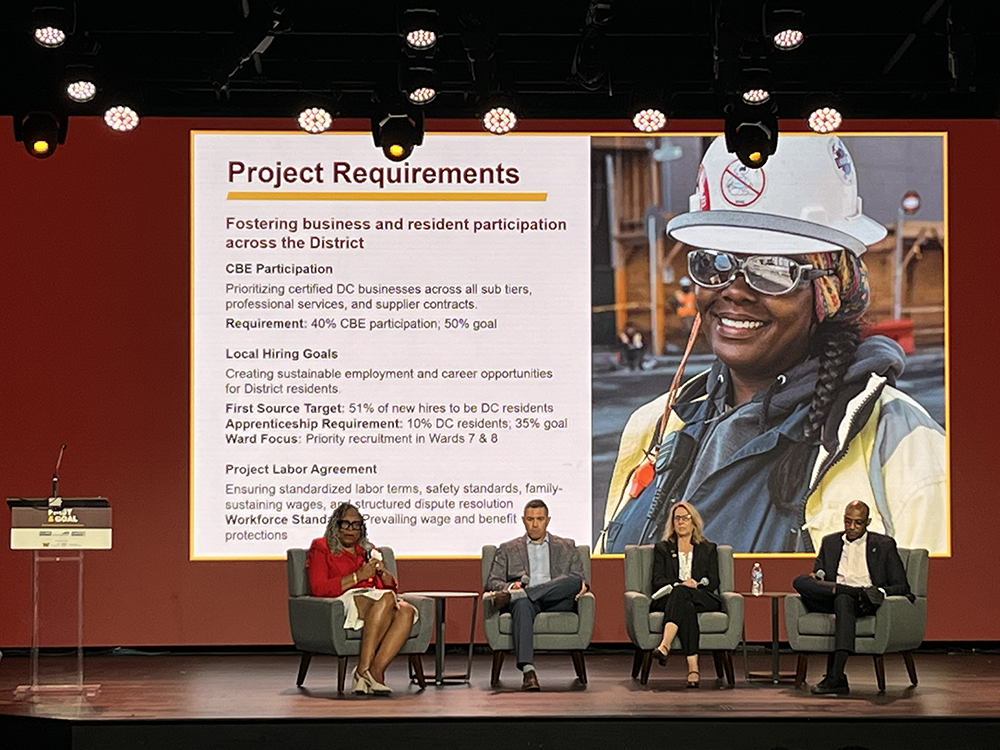
ABOVE: Panelists discuss upcoming construction opportunities for D.C. residents and small businesses at the Sept. 9th “First & Goal” Construction Kick-off & Resource Expo. Photo: Michael Blain.
The District of Columbia marked a historic milestone on Sept. 9th at the “First & Goal” Construction Kick-off & Resource Expo for the new 65,000-seat Washington Commanders stadium at the 180-acre RFK campus.
Beyond delivering a state-of-the-art sports and entertainment venue, the $2.2 billion project will serve as a generational economic engine focused on workforce development, local hiring and long-term construction career pathways for D.C. residents.
The RFK stadium redevelopment includes a mandate that over 50% of new hires be District residents — with priority hiring in Wards 7 and 8.
The RFK stadium redevelopment includes a mandate that over 50% of new hires be District residents — with priority hiring in Wards 7 and 8.
Local elected leaders underscored that the project must directly translate into workforce opportunities for local residents. D.C. Mayor Muriel Bowser outlined aggressive participation targets, including a mandate that over 50% of new hires be District residents — with priority hiring in Wards 7 and 8 — alongside a target of 50% Certified Business Enterprise (CBE) participation.
Urging local entrepreneurs to prepare for these contracting opportunities, Mayor Bowser emphasized, “My job is not to make sure that you win. My job is to make sure that I create opportunities. And your job is to make sure you win.
Operating Under a Unified Project Labor Agreement (PLA)
A central pillar of the project’s labor and operational strategy is that it will operate under a Project Labor Agreement (PLA), for both stadium construction and surrounding retail and hospitality development.
Executed between joint venture builder Clark | Mortenson | SmootDC (CMS) and the Baltimore-D.C. Metro Building Trades Council, the PLA will leverage skilled union labor while ensuring pathways for local residents and small businesses.
Greg Akerman, President of the Baltimore-D.C. Building Trades Council, detailed how the PLA standardizes working conditions, prohibits strikes and lockouts, and sets transparent wage structures across all trades. Speaking to the concrete benefits for participating contractors and labor, Akerman emphasized that the agreement provides:
Proponents also emphasized what the landmark PLA would have achieved, and how responsive the developer had been to community concerns:
- Opportunities for local contractors to grow their business by bidding on large-scale infrastructure work.
- Access to a highly skilled and local workforce across all trade disciplines.
- Unbiased and fair competition because “everybody is bidding under the same conditions.”
CMS Project Director Ben Eitan highlighted the collaborative scale required for the build, noting that “delivering a project this magnitude requires broad participation”. Eitan explained that “the PLA will enable us to leverage the strength and skill of union labor, while creating pathways for small, local and certified business enterprises to play a major role in the stadium’s construction.”
“The PLA will enable us to leverage the strength and skill of union labor, while creating pathways for small, local and certified business enterprises to play a major role in the stadium’s construction.”
– Ben Eitan, Project Director
Clark | Mortenson | SmootDC (CMS)
“The PLA will enable us to leverage the strength and skill of union labor, while creating pathways for small, local and certified business enterprises to play a major role in the stadium’s construction.”
– Ben Eitan, Project Director
Clark | Mortenson | SmootDC (CMS)
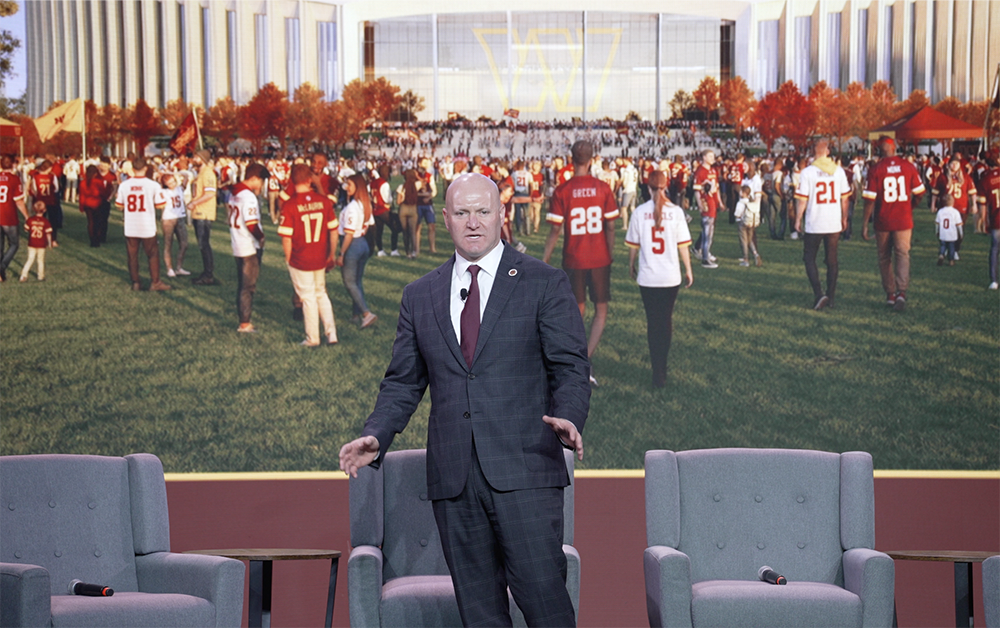
Clark | Mortenson | SmootDC (CMS) Project Director Ben Eitan speaks at the Sept. 9 “First & Goal” event. Photo: Michael Blain.
Akerman also highlighted the Mid-Atlantic building trades’ substantial investment in workforce training, noting that area trade unions spend “about $60 million annually on our joint apprenticeship training and journeyman upgrade programs”. To guarantee local resident inclusion, the PLA incorporates priority referral goals through union hiring halls, targeting 20% of resident journeyman hours and 50% of resident apprentice hours.
Under the agreement, all contractors — whether union or non-union — are obligated to pay the higher of Davis-Bacon prevailing wages or collective bargaining rates, ensuring equal standards across the site.
Expanding Local Economic Opportunity & Career Pathways
With groundbreaking scheduled for Spring 2027, the stadium project stands as a model for community-centered infrastructure.
Washington Commanders Team President Mark Clouse framed the stadium build as assembling a championship roster, reaffirming the organization’s commitment to “driving the local investment and ensuring that the stadium is built by local community for the community.”
Adding to this vision, Commanders’ Head of Construction Matt Haas announced the launch of the Commanding Careers Access Program (CAP), an initiative designed to establish career pathways before construction demand peaks
“This project is not just about building a stadium. We are building opportunities. We are building careers. We are building businesses. We are building a stronger Ward 7 and we are building a stronger Washington D.C.”
– Wendell Felder
DC Councilmember (Ward 7)
“This project is not just about building a stadium. We are building opportunities. We are building careers. We are building businesses. We are building a stronger Ward 7 and we are building a stronger Washington D.C.”
– Wendell Felder
DC Councilmember (Ward 7)
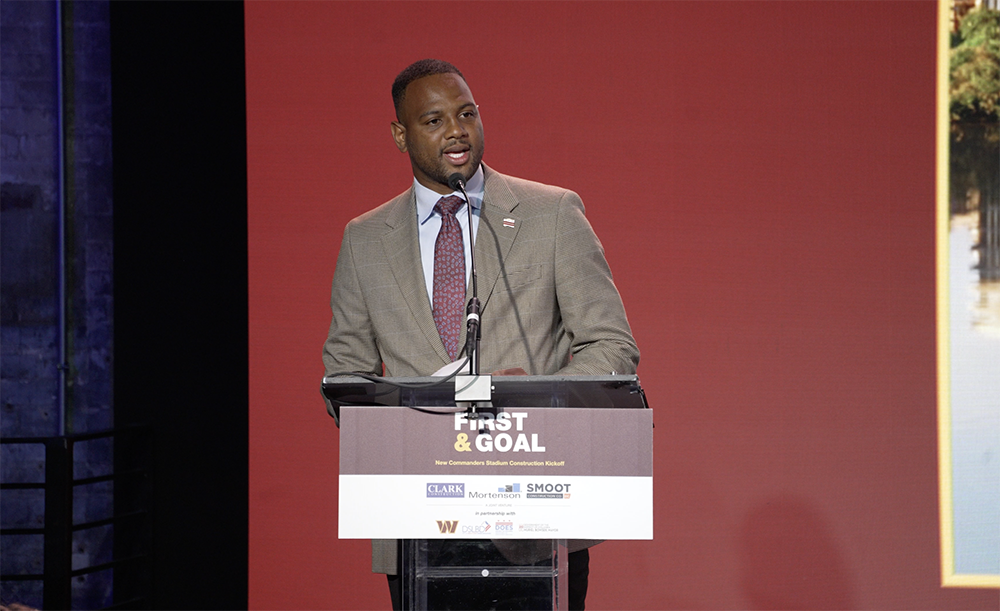
DC Councilmember Wendell Felder (Ward 7) speaks at the Sept. 9 “First & Goal” event. Photo: Michael Blain.
“Rather than waiting until contractors need workers and hoping District residents find their way through what can be a complicated process,” Hass explained, “we are building the pathways before the hiring demand arrives.”
Haas underscored that the venue “is built for this community, by this community, and leaves a lasting legacy for generations to come.”
For DC Councilmember Wendell Felder (Ward 7), the stadium project represents a vital catalyst for community revitalization and wealth creation east of the Anacostia River.”This project is not just about building a stadium,” said Felder. “We are building opportunities. We are building careers. We are building businesses. We are building a stronger Ward 7 and we are building a stronger Washington D.C.”