

The days when vocational training was viewed as a “backup plan” are rapidly receding in the rearview mirror.
Today, building trades unions across the Mid-Atlantic are seeing record-breaking surges in both program interest and apprenticeship enrollment. Several local unions report that apprenticeship application numbers have doubled or even tripled in recent years, driven by a desire for debt-free education, hands-on work outside an office setting, and stable career pathways with family-sustaining pay and benefits.
Record Apprenticeship and Membership Growth
At a time when total private sector U.S. union membership continues to dip to new lows, many building trades unions are bucking that trend — in a big way.
One union helping lead the charge is IBEW Local 24, which has seen unprecedented growth in both its membership and its training program in recent years. This influx includes workers already in the industry leaving non-union positions for the stability of a union career
“We are getting record applications through our advertising and organizing efforts. And apprentices in non-union programs are leaving to come and join ours.”
– IBEW Local 24 Training Director David Springham
“We are getting record applications through our advertising and organizing efforts. And apprentices in non-union programs are leaving to come and join ours”
– IBEW Local 24 Training Director David Springham

IBEW Local 24 Training Director David Springham speaks with an attendee at a job fair in 2025. Photo: Michael Blain
“We are getting record applications through our advertising and organizing efforts,” said IBEW Local 24 Training Director David Springham. “And apprentices in non-union programs are leaving to come and join ours.”
Springham says the local has grown from roughly 2,000 members to over 3,100 in just two years — an increase of more than 50 percent.
The local is seeing a record number apprenticeship applications, and is now scheduling 150 people every other week for aptitude tests. In 2025, says Springham, Local 24 had “right around 2200 applications.” Of those, 260 were accepted as 1st-year apprentices. In 2026, he says, the local is on pace for about 2800 applicants. It will again have a 1st-year class size of around 260 students (effectively meaning the program is getting more selective as applications continue to increase).
Similarly, Jamie Buck, Business Manager with Operative Plasterers’ and Cement Masons’ Local 891, has seen his local’s apprenticeship applications, apprenticeship class sizes and active membership all more than double during his four-and-a-half-year tenure. The local has grown from 125 active members just over four years ago to nearly 280 currently.
Buck emphasizes the long-term security these programs provide: “Anyone who is looking at a trade in general… this is a secure union opportunity where you get a good wage in your pocket. You can get benefits behind it, you can have a retirement, you can have a pension.”
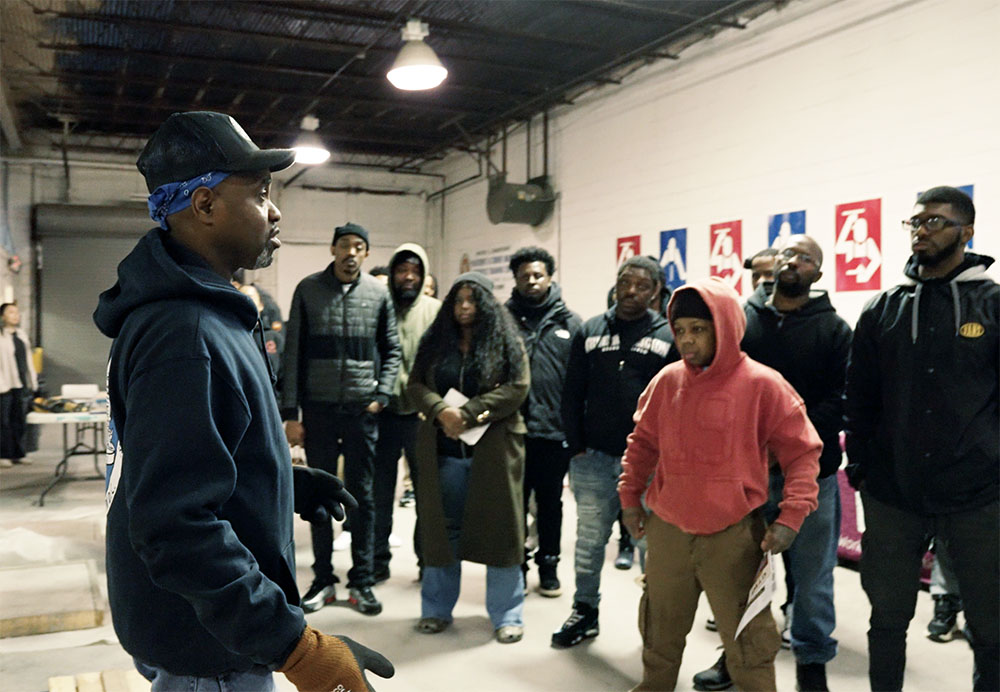
Jamie Buck, Business Manager for Local 891 of the Operative Plasterers’ and Cement Masons’ International Association (OPCMIA), speaks at a Feb. 2026 info session for the Raising the Bar pre-apprenticeship program. Photo: Michael Blain
Data Centers, Infrastructure Projects Drive Demand for Skilled Trades
The digital revolution is quite literally being built out by the union trades, as data center development increases demand for skilled labor. These facilities require complex electrical grids and high-capacity cooling systems, making them a primary source of steady, high-paying work for electricians and mechanical trades, among others.
In addition to data centers, large regional infrastructure projects such as the Frederick Douglas Tunnel and the Key Bridge rebuild in Baltimore, as well as the RFK Stadium redevelopment, are driving growing demand for skilled labor.
UA Local 486 Training Director Charlie Petrovia identified data centers as the “key driver” for his local’s surging membership and apprenticeship needs, as new projects continue to break ground across the region.
IBEW’s Springham echoed this sentiment, calling data center work “the exact reason for the recent explosion [in work hours].” He estimated that roughly half of the local’s current work hours are now tied to data center projects.
“I feel like the trades are not the backup plan. They’re the primary plan.”
– UA Local 486 Training Director Charlie Petrovia
“I feel like the trades are not the backup plan. They’re the primary plan.”
– UA Local 486 Training Director
Charlie Petrovia

UA Local 486 Training Director Charles Petrovia discusses his union’s apprenticeship program during a May 2026 Zoom call.
A Flood of Apprenticeship Applications
Growing enthusiasm for the trades is visible at training centers across the region. For example, UA Local 486 reports that interest has effectively tripled in just two years.
“Two years ago, we had 450 applicants,” said UA Local 486’s Charles Petrovia, adding that the number of applications jumped to over 1,300 this year alone.
To meet this demand, Local 486 increased its first-year class size to 128 —the facility’s maximum capacity. The local is also investing $30 million to transform a shuttered sports arena in White Marsh, Md., into a state-of-the-art union training center. The new facility will enable the local to further expand its apprentice and journeyman programs.
“I feel like the trades are not the backup plan,” said Petrovia. “They’re the primary plan.”
Numerous other Mid-Atlantic locals are on pace for new records in the number of applications to their apprenticeship programs.
Plumbers and Gasfitters Local 5 Training Director Mason Holden says his local’s apprenticeship program is on track to “blow past” last year’s 1,200 applications, with over 600 already submitted by early May of 2026.
“The light is definitely shining on the trades more so than ever,” said Holden.
Gary Armstrong, Business Manager for Ironworkers Local 5, said his local’s apprentice class size more than doubled year-over-year, to 180 students now, with a goal to exceed 200 soon
Armstrong sees a decade of work ahead: “The future is opportunities… we see a long pipeline of work where you can keep steady work.”
Plumbers and Gasfitters Local 5 says its apprenticeship program is on track to “blow past” last year’s 1,200 applications, with over 600 already submitted by early May of 2026.
Plumbers and Gasfitters Local 5 says its apprenticeship program is on track to “blow past” last year’s 1,200 applications, with over 600 already submitted by early May of 2026.
Strategic Policy and Workforce Investments
In Maryland, worker enthusiasm for apprenticeship opportunities is being bolstered by significant state-level support. In early 2026, Governor Wes Moore announced that the state had met its ambitious apprenticeship pledge, with programs recruiting more than 5,200 new registered apprentices in a single year. This brought the total number of Marylanders in apprenticeship programs to an all-time high of 14,000.
A cornerstone of this effort is the RAISE Act of 2025, which established the Maryland Office of Apprenticeship. This legislation invested millions into staff capacity — hiring 14 new apprenticeship navigators — and created employer incentives to further scale these opportunities across the state.
The “AI Factor” and Career Guidance
Another catalyst for growing interest in apprenticeship programs is concern about the impacts of artificial intelligence and job automation on employment opportunities. Area building trades training directors say they are hearing from applicants who want a “future-proof” career that cannot be replaced by technology.
Alexander Barham, Apprenticeship Coordinator for Ironworkers Local 5, noted that some applicants are moving away from white-collar paths due to AI fears, as well as massive federal layoffs and hiring freezes. Barham encourages those ready to work to consider the ironworking trade, saying: “If you’re not scared of hard work, it is one of the best opportunities you can find in the United States of America.”

Operating Engineers Local 99 Training Coordinator Mark Brandt discusses his union’s apprenticeship program during a May 2026 Zoom call.
“When I started as the training coordinator 10 years ago, we saw a lot of ‘gatekeeping’ by guidance counselors and such at the high school level… Now, the career counselors are constantly reaching out to trades like mine.”
– Operating Engineers Local 99 Training Coordinator Mark Brandt
Training directors also say they have seen recent and dramatic reversals in the attitudes of high school guidance counselors.
“When I started as the training coordinator 10 years ago,” said Operating Engineers Local 99 Training Coordinator Mark Brandt, “we saw a lot of ‘gatekeeping’ by guidance counselors and such at the high school level.”
He says many counselors believed the only mark of student success would be if they went on to college. Counselors typically did not share with students other options for secondary or post-secondary education, including building trades apprenticeships.
“That whole way of thinking has done 180 degrees,” added Brandt, “Now, the career counselors are constantly reaching out to trades like mine.”
Brandt says Local 99’s apprenticeship application numbers jumped from 65 in 2023 to 183 in 2025, a nearly three-fold increase.
A Secure Path to the Middle Class
The Mid-Atlantic data is clear: Building trades apprenticeship programs are not simply growing. They are undergoing a rapid and historic expansion.
Whether you are a high school student, a mid-life career changer, or someone concerned about an AI-driven future, the building trades offer abundant opportunities for debt-free education, development of high-demand skills, great pay and benefits, and a stimulating lifelong career.